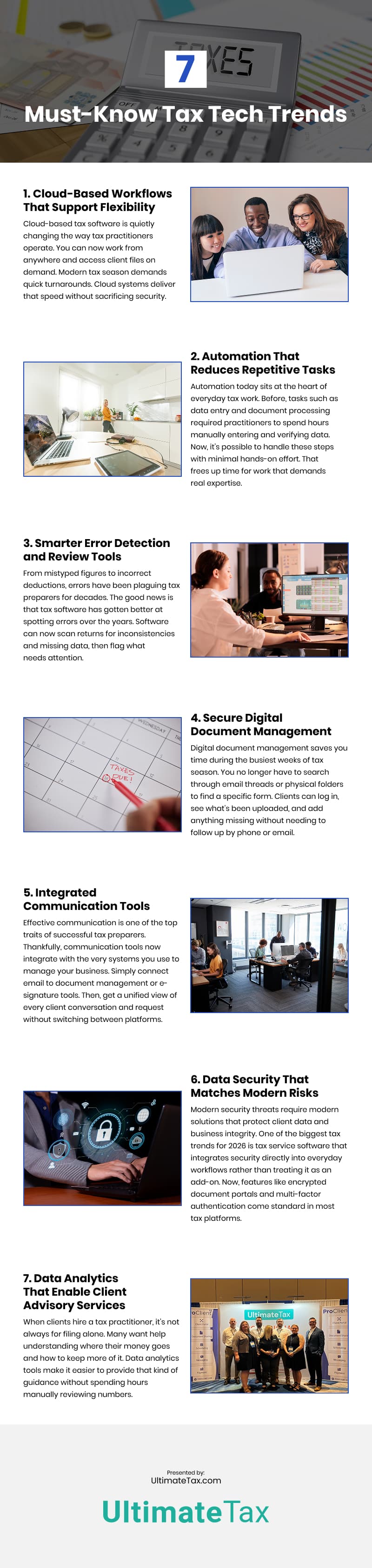

Change has always been part of tax work, but the pace keeps getting faster. New tools and client expectations are reshaping the industry.
For tax services businesses, these changes affect how you deliver services and operate day to day. Staying relevant means watching where the industry is headed and taking steps to stay competitive.
Which developments are worth paying attention to? Here’s a closer look at seven tax tech trends that are reshaping the industry and what they mean for tax services businesses.
1. Cloud-Based Workflows That Support Flexibility
Cloud-based tax software is quietly changing the way tax practitioners operate.
You can now work from anywhere and access client files on demand. Modern tax season demands quick turnarounds. Cloud systems deliver that speed without sacrificing security.
Staff collaboration gets easier with shared access. Team members can jump into the same file and keep work moving without waiting for handoffs. When everyone sees updates as they happen, workflows flow more smoothly. This flexibility keeps operations steady even when schedules shift or unexpected issues arise.
The impact on client relationships shows up quickly. Faster responses and fewer delays improve their experience and build the kind of trust that turns into long-term partnerships.
2. Automation That Reduces Repetitive Tasks
Automation today sits at the heart of everyday tax work. Before, tasks such as data entry and document processing required practitioners to spend hours manually entering and verifying data. Now, it’s possible to handle these steps with minimal hands-on effort. That frees up time for work that demands real expertise.
The best way to adopt automation is to start with software that handles one or two specific tasks well. Look for tools that integrate with existing systems and don’t require a complete workflow overhaul. It also helps to test automation during slower periods before rolling it out during tax season.
3. Smarter Error Detection and Review Tools
From mistyped figures to incorrect deductions, errors have been plaguing tax preparers for decades. It’s easy to overlook details when workloads spike, especially during peak season. The good news is that tax software has gotten better at spotting errors over the years. Software can now scan returns for inconsistencies and missing data, then flag what needs attention.
Tools are also available to assign risk scores based on patterns and regulatory requirements. These systems help practitioners decide which returns need closer review and which ones are ready to file. Less time hunting for problems means more time for the work that requires expertise.
4. Secure Digital Document Management
Paper continues to give way to digital document handling.
Secure portals and organized file storage simplify how your clients share information and how you retrieve it later. Organization becomes easier when everything lives in one place.
Digital document management saves you time during the busiest weeks of tax season. You no longer have to search through email threads or physical folders to find a specific form. Clients can log in, see what’s been uploaded, and add anything missing without needing to follow up by phone or email.
Modern document management also supports record retention requirements. When your files remain accessible and organized year after year, complying with IRS guidelines becomes straightforward rather than stressful.
5. Integrated Communication Tools
Effective communication is one of the top traits of successful tax preparers. It’s a key factor clients consider when choosing who handles their returns.
Thankfully, communication tools now integrate with the very systems you use to manage your business. Simply connect email to document management or e-signature tools. Then, get a unified view of every client conversation and request without switching between platforms.
The integration also improves how quickly you can respond. Client uploads and questions appear instantly in your workflow, eliminating the need to monitor multiple systems.
6. Data Security That Matches Modern Risks
Modern security threats require modern solutions that protect client data and business integrity. One of the biggest tax trends for 2026 is tax service software that integrates security directly into everyday workflows rather than treating it as an add-on. Now, features like encrypted document portals and multi-factor authentication come standard in most tax platforms.
These features allow you to protect your practice without needing deep technical knowledge. Clients appreciate knowing that their documents are encrypted, that access requires more than just a password, and that systems stay updated against new threats.
7. Data Analytics That Enable Client Advisory Services
When clients hire a tax practitioner, it’s not always for filing alone. Many want help understanding where their money goes and how to keep more of it. Data analytics tools make it easier to provide that kind of guidance without spending hours manually reviewing numbers.
Metrics like effective tax rates and year-over-year spending patterns help you spot opportunities clients might miss on their own. Maybe estimated payments need adjusting, or a business expense category shows room for better planning. These insights turn a one-time filing relationship into ongoing advisory support.
Clients value this kind of proactive help far more than basic compliance work. For solo practitioners, shifting from simply filing to advising positions you as a strategic partner. You’re no longer the seasonal service provider who only shows up once a year.
Adapting to These Tax Trends
Tech evolves. Adapting gradually makes it easier to stay current without the stress of implementing everything at once.
Begin by focusing on one or two trends. Then see whether you can adopt them immediately or whether you need additional training or tools first.
Also consider:
- Testing cloud-based platforms that offer free trials before committing
- Attending webinars or industry events to see what other practitioners are using
- Asking peers what tools have made their work easier or more efficient
- Prioritizing tools that integrate with systems already in place
- Revising pricing models to reflect the value of advisory work (rather than hours spent)
As trends change, the steps you take now determine how prepared you are later.
Video

Infographic
Change is constant in tax work, but its pace is accelerating. New technologies and rising client expectations are reshaping how firms operate and deliver value. This infographic highlights seven key tax technology trends and what they mean for tax services businesses.